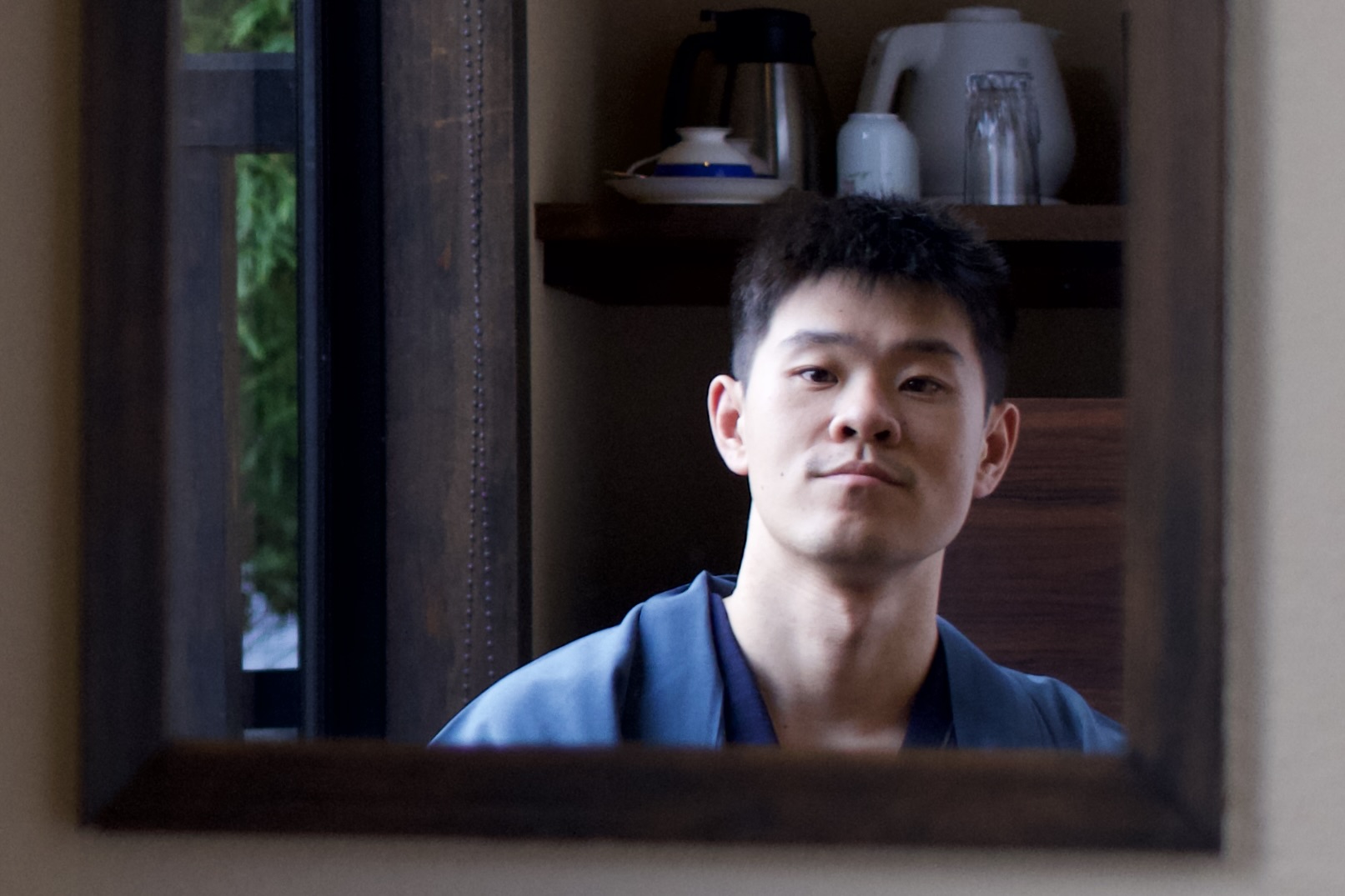
Haopeng Geng is a Ph.D. candidate in Electrical Engineering and Information Systems at the University of Tokyo. His research in Human-Centered Speech AI develops perceptually meaningful acoustic and phonetic models and speech representations for understanding L2, accented, and pathological speech.
Before beginning his Ph.D., he worked full-time as an AI Software Engineer at Laronix, an Australian MedTech start-up, developing practical speech technologies to support communication for the voice-loss community.
📣 News
-
[Oct 2026] I will join the University of British Columbia in November 2026 as a Visiting International Research Student (VIRS), working with Prof. Jian Zhu on phonetic foundation models.
-
[Sep 2026] Our paper on subphonetic acoustic modeling was accepted at SLT 2026.
-
[Feb 2026] 🥈 Our UTokyo team placed 2nd in the Iqra’Eval2 Challenge at INTERSPEECH 2026.
See our prompt-free MDD paper, code, and checkpoints. -
[Aug 2025] We released the full implementation of IF-MDD, our prompt-free framework for mispronunciation detection and diagnosis.
-
[Feb 2025] Our paper on perception-based L2 intelligibility was accepted at INTERSPEECH 2025.
Read the paper and explore the demo of our shadowing-based framework.
📝 Publications
-
Subphonetic Acoustic Modeling via Optimal Transport for Pronunciation Assessment
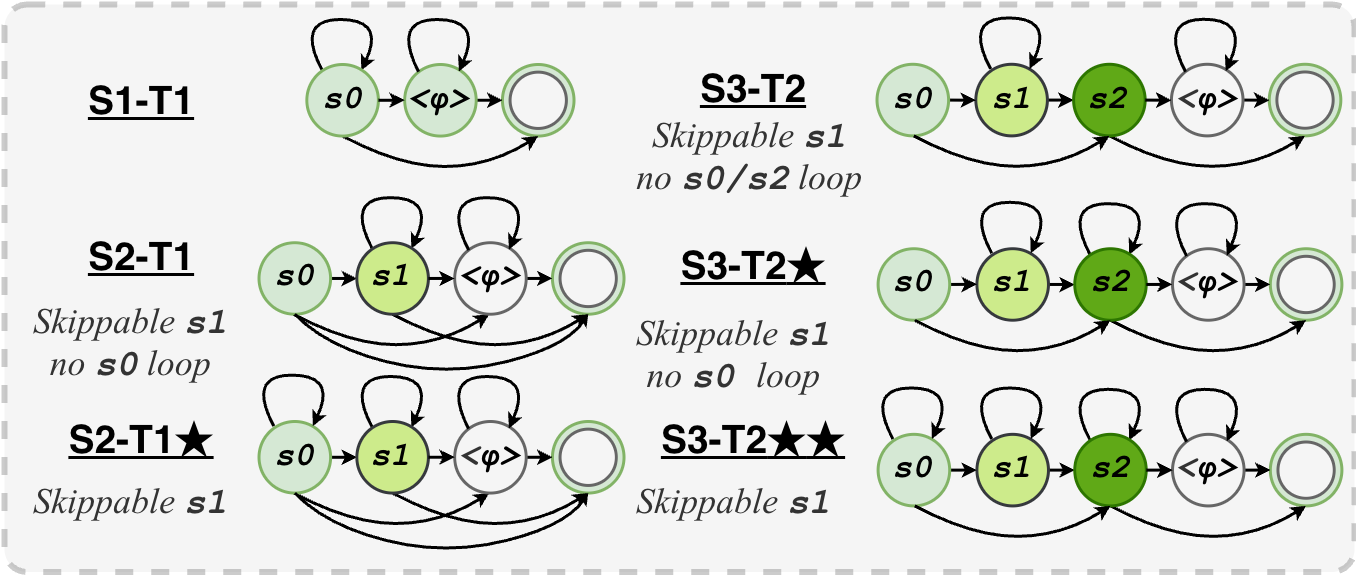
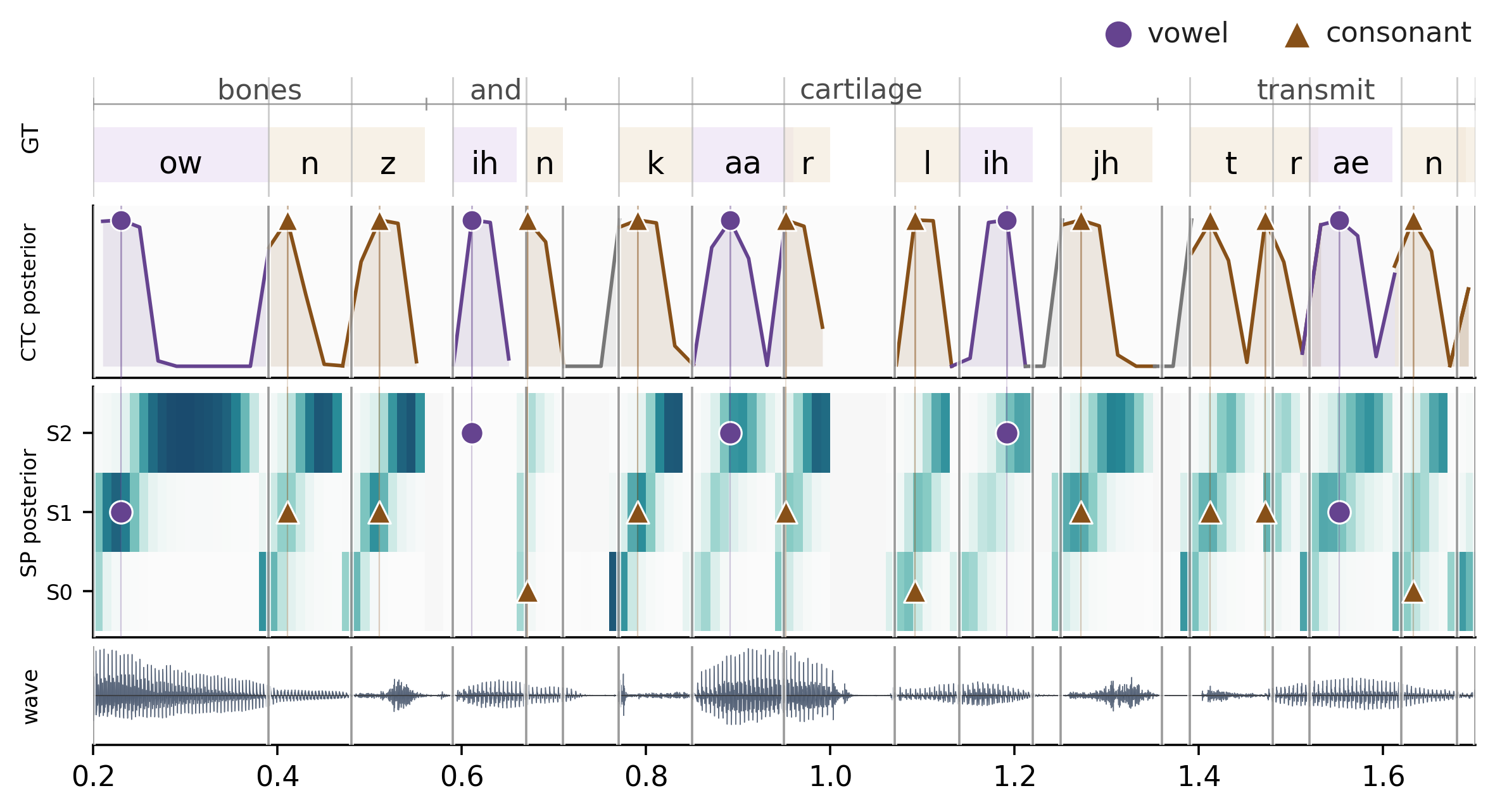
Haopeng Geng, Jiun-Ting Li, and et al.- Subphonetic Acoustic Modeling - Expands each phone into ordered internal states, producing dense frame-level acoustic evidence beyond sparse CTC peaks.
- Optimal Transport Training - Learns monotonic frame-to-state alignments with topology-aware optimal temporal transport, without requiring manual frame labels.
- Pronunciation Assessment - Provides more precise phone-internal timing and acoustic cues for segmentation, mispronunciation detection, and automatic pronunciation assessment.
-
Beyond Acoustic Sparsity and Linguistic Bias: A Prompt-Free Paradigm for Mispronunciation Detection and Diagnosis
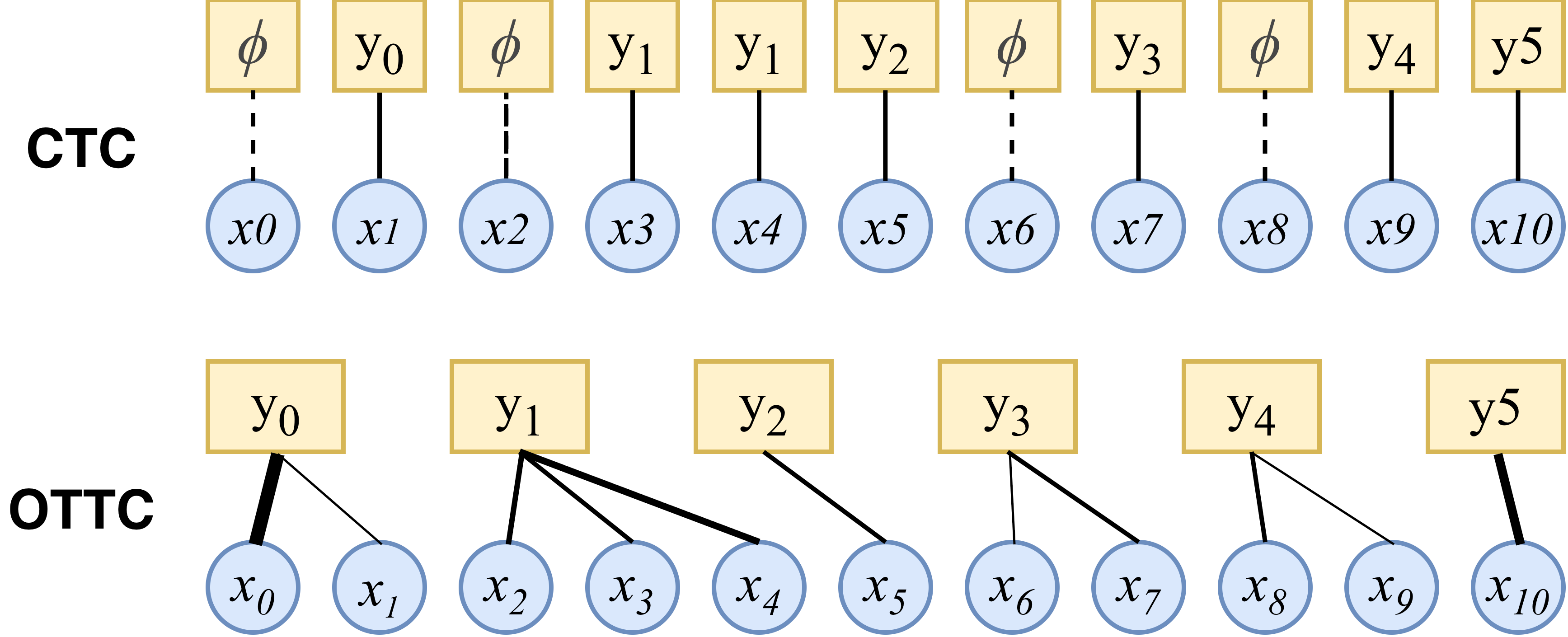
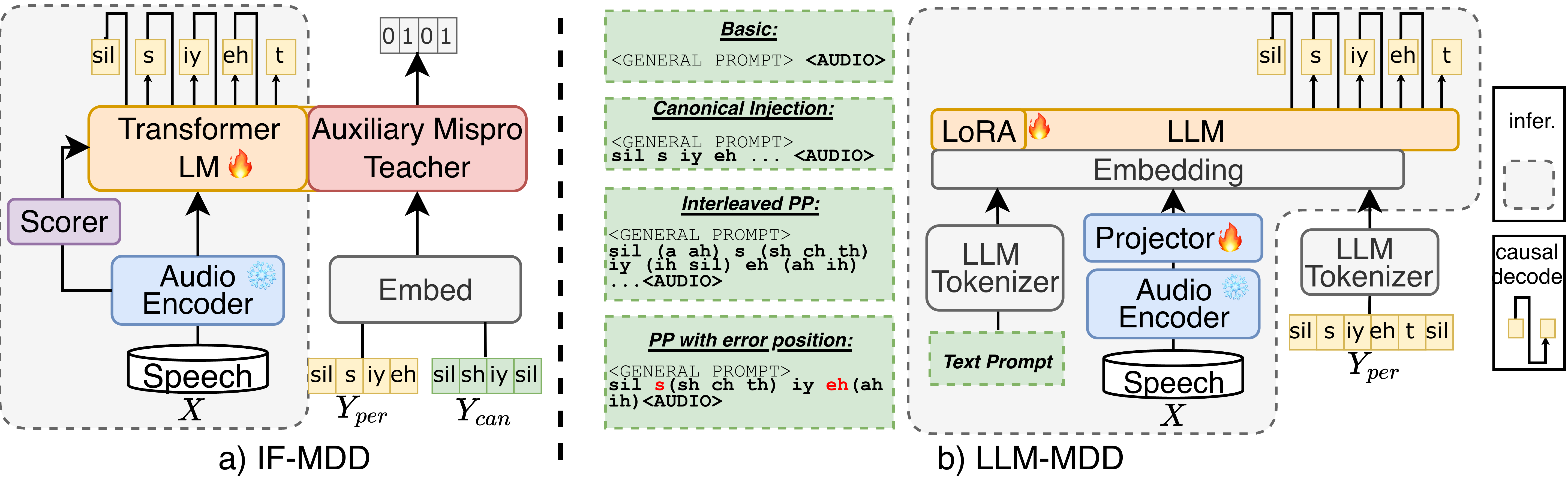
Haopeng Geng, Longfei Yang, Xi Chen et al.🥈 Ranked 2nd in the Iqra'Eval2 Challenge 2026- CROTTC Front-end - Introduces a dense acoustic front-end for capturing fine-grained phonetic deviations beyond the sparse peaks produced by conventional CTC models.
- Indirect Fusion & Prompt-free Inference - Transfers pronunciation-specific cues into a language model during training, enabling inference without a text prompt.
- LLM Limitation Analysis - Examines how linguistic priors can override acoustic evidence in fine-grained phonetic recognition.
- IF-MDD: Indirect Fusion for Prompt-free Mispronunciation Detection and Diagnosis
Haopeng Geng, Daisuke Saito, Nobuaki Minematsu.
🎧Demo, 💻GitHub Repo
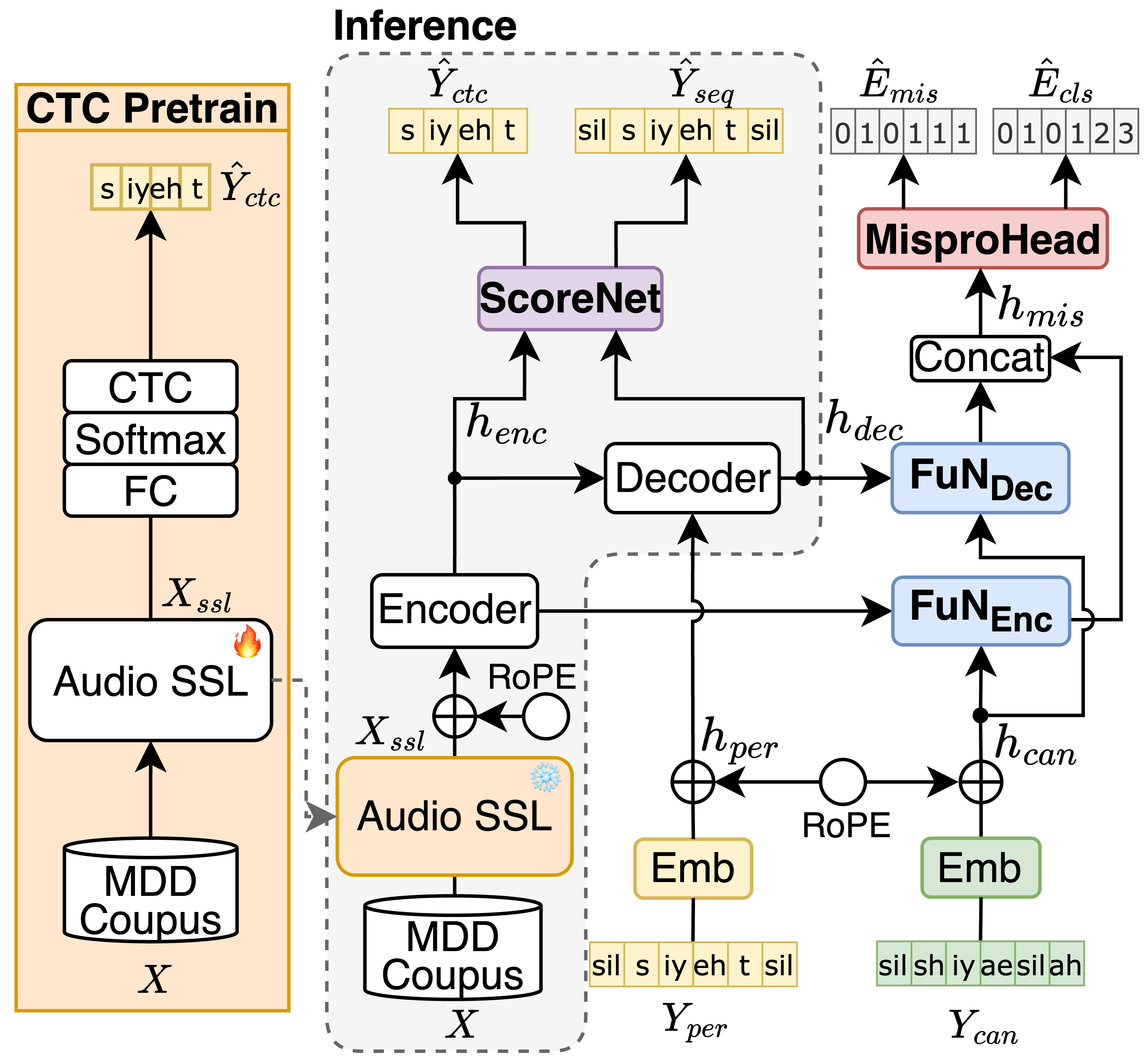
- Prompt-free Mispronunciation Detection - Developed IF-MDD, an indirect fusion framework that leverages canonical phonemes only during training, enabling inference without text prompts.
- Strong Diagnostic Performance - Achieved 60.67% F1 and 19.98% error diagnosis rate on L2-ARCTIC, showing competitive results even with limited training data.
- Robust Generalization - Demonstrated reliable performance across unseen speakers from diverse L1 backgrounds, highlighting scalability for real-world CALL applications.
- A Perception-Based L2 Speech Intelligibility Indicator: Leveraging a Rater’s Shadowing and Sequence-to-sequence Voice Conversion
Haopeng Geng, Daisuke Saito, Nobuaki Minematsu.
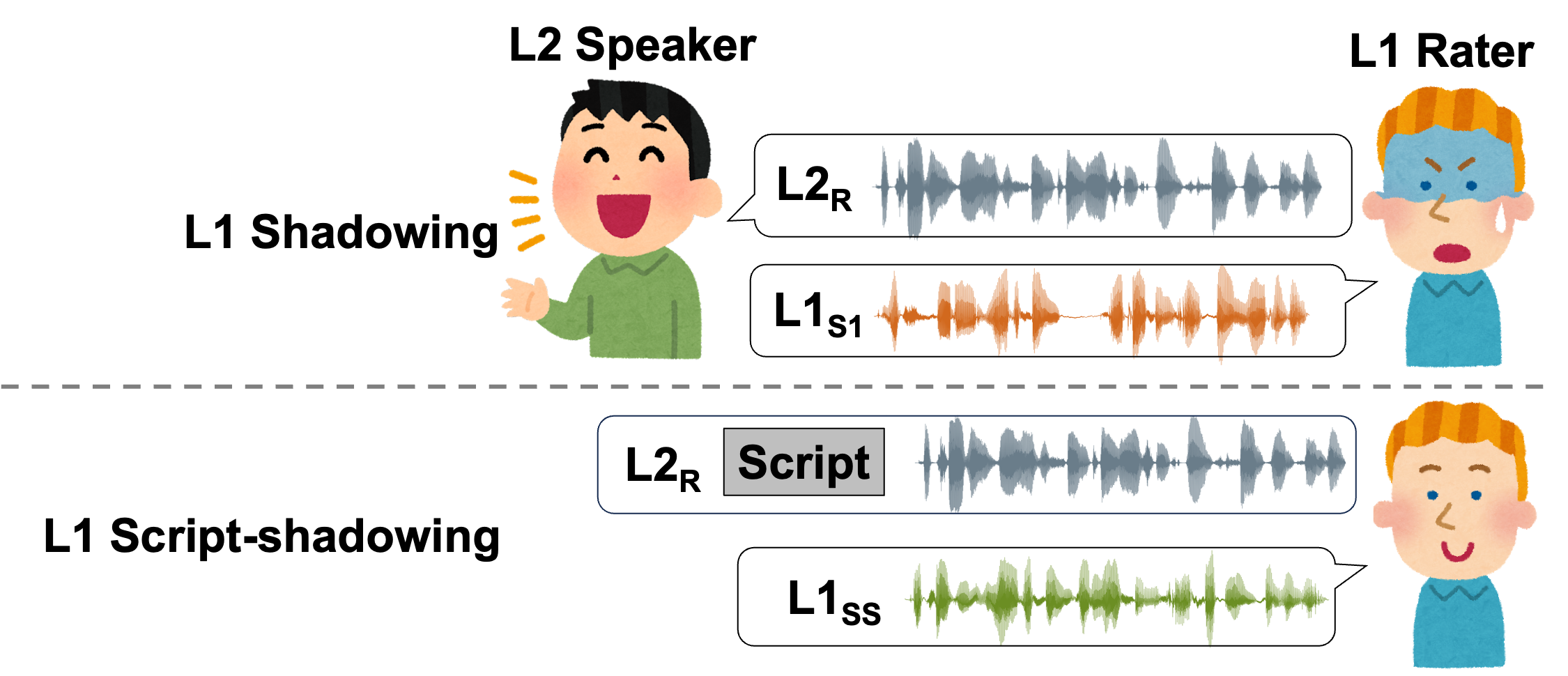
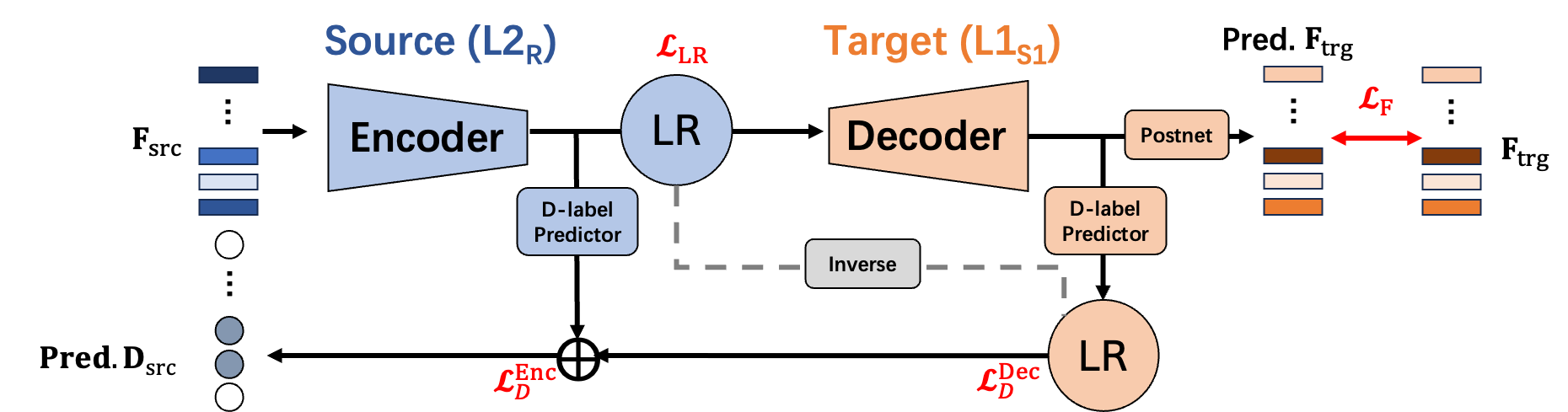
🎧Demo- Customized Intelligibility Indicator – Proposed a novel metric leveraging native raters’ shadowing data, focusing on perceptual cues rather than purely native-like pronunciation.
- Seq2Seq Voice Conversion Framework – Applied alignment and acoustic reconstruction modules to simulate how native listeners detect unintelligible segments.
- Multi-Task Learning for Feedback – Jointly optimized speech reconstruction and disfluency detection, achieving closer alignment with native raters’ judgments than mainstream ASR and enabling more personalized CALL feedback.
-
SlaTE 2025
Synthesizing True Golden Voices to Enhance Pronunciation Training for Individual Language Learners
Ryoga Yamanaka, Kento Osa, Akari Fujiwara, Haopeng Geng, Daisuke Saito, Nobuaki Minematsu, Yusuke Inoue. -
Preprint, 2025
Simulating Native Speaker Shadowing for Nonnative Speech Assessment with Latent Speech Representations
Haopeng Geng, Daisuke Saito, Nobuaki Minematsu
🎧Demo -
APSIPA ASC 2024
A Pilot Study of Applying Sequence-to-Sequence Voice Conversion to Evaluate the Intelligibility of L2 Speech Using a Native Speaker’s Shadowings
Haopeng Geng, Daisuke Saito, Nobuaki Minematsu.
🎧Demo, 💻GitHub Repo -
ASJ 2022
Disfluency Removal with Speech Inpainting on Spontaneous Lecture Speech
Haopeng Geng, YASUDA Yusuke, Tomoki Toda.
📖 Education
- The University of Tokyo, Japan — Ph.D. Candidate in Engineering, Apr 2024–Present
Supervisor: Prof. Nobuaki Minematsu
Doctoral research: fine-grained acoustic and phonetic modeling, speech representation learning, and spoken-language assessment. - Nagoya University, Japan — M.S. in Informatics, Apr 2020–Mar 2022
Supervisor: Prof. Tomoki Toda
Thesis: Speech conversion and inpainting for editing disfluencies in spontaneous speech. - Dalian University of Technology, China — B.S. in Computer Science and Technology; B.A. in Japanese, Sep 2014–Jun 2019
💬 Full-Time Work Experience
AI Software Engineer (Full-time) · Laronix Pty Ltd · Australia · Mar 2022–Mar 2024
Continued part-time through Oct 2024
- Collected and curated real-world speech data with the voice-loss community, establishing datasets for personalized speech recognition and voice conversion.
- Developed personalized speech recognition and voice conversion systems to improve intelligibility and support everyday communication for people with voice loss.
- Built a clinician-facing platform to quantitatively assess speech intelligibility and naturalness and track changes over time.
💻 Internships & Research Experience
Technical Intern · CoeFont Co., Ltd. · Tokyo · Mar–Sep 2025
- Explored Parakeet-TDT adaptation for streaming Japanese ASR, and evaluated CosyVoice for speech synthesis and Emilia-Pipe for speech-data preprocessing.
Research Assistant · Carriage Inc. · Tokyo · Jan–Sep 2025
- Built a Japanese oral-proficiency assessment pipeline using speech from approximately 50 non-native speakers; 98% of held-out predictions fell within one CEFR level of the reference labels.
Technical Assistant · Nagoya University · Nagoya · Jul 2022–Dec 2023
- Supported large-scale speech-database collection and high-performance computing workflows.
Research Intern · NTT Human Informatics Laboratories · Japan · Feb & Sep 2021
- Investigated speech emotion recognition and speaker diarization using self-supervised speech representations.
🎖 Honors and Awards
- 2nd Place, Iqra’Eval2 Challenge, INTERSPEECH 2026 · Feb 2026
- Miyabi Supercomputer Resource Grant, The University of Tokyo · Mar 2025–Present
- SPRING GX Fellowship, The University of Tokyo · Apr 2024–Present
- Graduate Program for Real-World Data Circulation Leaders, Nagoya University · Apr 2020–Mar 2022
- Scholarship for Outstanding Undergraduate Students, China Scholarship Council · Sep 2017–Aug 2018